Monday, December 7, 2009
Dubliners by James Joyce/Nine Stories Reflection
Dubliners is a collection of short stories by the Irish author James Joyce. Similarly to the other collection of short stories I read earlier this year, J.D. Salinger's Nine Stories, Dubliners, rather than focusing on any particular family or series of events, is meant to evoke a time and a place. For Nine Stories, the place was the lives of the American upper-middle class, 1940s through 1950s. Dubliners crosses the Atlantic to middle-class Dublin, where everybody knows everybody and everybody is the same. The stories in these two collections are not particularly intriguing or noteworthy in any way, but the way the character's lives are painted by Salinger and Joyce makes the stories fascinating. The consciousness of the reader in "A Perfect Day For Bananafish" that something bad will happen soon is a result of the dread infused into the tale by Salinger's words. Each writer also uses the innocence of children as a device in certain stories. In Salinger's "The Laughing Man" the reader can see how the story the leader is telling reflects how his own relationship with his girlfriend is going, while the child in the story cannot connect the two instances. Likewise, the death of Father Flynn in "The Sisters" is told through the eyes of a child who knew the priest well, not to deaden the loss, but rather to enhance it. The reader and the child both realize that the priest is dead, but it is the reaction of the adults that make the story.

Thursday, December 3, 2009
Friday Night Lights (Finish)
The final parts of the book deal with Permian's playoff run and the subsequent careers of the graduating seniors. First, Permian finishes their season in a three-way tie for the league title. Since only two teams can go to the state playoffs, there needs to be a tiebreaker to determine the league champions. This tiebreaker takes the form of a coin toss. The rules are simple: three coaches toss coins, and the odd one out loses. Permian manages to barely survive the toss and their next three playoff games. This sets up a semifinal match against the Carter Cowboys, a team that mans four future NFL players, including 5-time Pro Bowl linebacker Jessie Armstead. While Permian players get preferential treatment at school, the Carter players barely have to go to class. They routinely received answer sheets along with tests, and were beneficiaries of a grading system that valued tests as much as showing up to class everyday. Even so, there was an academic scandal surrounding that year's team that would lead to Carter forfeiting its eventual state title. After Permian loses to Carter on the last play of the game, the book splits off into briefly covering how the graduating seniors react to the end of their careers. Some, like Ivory Christian, attend college, looking to play football. However, most burn out after realizing that college football cannot match the Mojo intensity. Don Billingsley, one of the hardest drinkers and partiers on the team, returned to Odessa and, while not exactly finding Jesus, quit alcohol and lived a healthier, cleaner life. "Boobie" Miles, the running back who tore his ACL, never quite recovered the breakaway speed that had made him a Division 1 college prospect. He bounced around at a junior college before finally returning to Odessa. Just about the only success story out of the Panthers is the one guy everyone knew would be a success. Brian Chavez, the #1 student in the class and Harvard-bound tight end, completes his term of study at Harvard and then goes on to law school at Texas Tech. After going to one Harvard junior varsity football practice, he realizes the enthusiasm is not there and never plays competitive football again.
Friday, November 20, 2009
Friday Night Lights by H.G. Bissinger (Post #2)
The section of the book I read this week deals with how the town of Odessa rallies around and supports their football. With the oil industry in the tank, the townspeople have nowhere to go and nothing to do except eat, sleep, and live football. The team support association, the Watermelon Feed, counts among its members most of the people in town, and nearly every business took out an ad in the team's yearbook. The townspeople dress almost exclusively in black and white (the Permian colors) during the season, and the coach is held to such a high standard of quality that "For Sale" signs are posted on his lawn after almost every loss. To be a Permian cheerleader (a "Pepette"), one must undergo a whole season of being in the service of one football player. The cheerleader is expected to do certain things, such as bake, for their player, although some cheerleaders have done much more. Overall, the Permian football experience may seem somewhat weird to an Ardsleyan who has not imagined that high-school football could be this intense, but for these people, it is their lives.
Thursday, November 12, 2009
Friday Night Lights by H.G. Bissinger
In Friday Night Lights, H.G. Bissinger is very clear in what his goal is: to write about high-school football. And not just any old, hooray-if-we-win football team; his case study is the Permian Panthers of Odessa, Texas, where stadium lights highlight the prairie every Friday night. Odessa is supported by two things: the vast reserves of oil and natural gas that create a vicious boom-bust cycle, and the routinely excellent football team. At the time, Permian were 4-time state champions in the toughest state for high school football in the nation, and yet the townspeople still grieved over each and every loss. The players Bissinger focuses on include Brian Chavez, a Harvard-bound tight end and "Boobie" Jones, a former star running back who is determined to prove that he can come back from a serious knee injury and still merit playing time. While this team will produce players that populate top programs around the nation, there are no NFL-bound supertalents here. Part of the interest here is that in the absence of a bona-fide star that all the hopes of a team are placed on, the reader is free to focus on the team as a whole, rather than just a LeBron James or a Randy Moss. (Couple notes: Dallas Cowboys wide receiver Roy Williams went to Permian, and Bissinger's latest book, More Than A Game, is co-authored with LeBron James about his high school team)
Wednesday, November 4, 2009
Quarter 1 Summary
With the first quarter ending Friday, it is a good time to look back on all the blogs I've written these past weeks. From Summer of the Gods to War of the Worlds, my reading has been varied and mostly challenging. Looking at the topics of the books, I have read a fair amount of non-fiction and historically themed books. The experience of blogging has been interesting. Previously, I had not been used to writing more than a couple of sentences at most about what I had been reading independently. However, I have enjoyed writing more about my books, because it allows me to express connections and thoughts I may have had about the book, but had not written down previously. While War of the Worlds is relatively easy to analyze and write about, I anticipate challenges down the roads with the other books, and I welcome those challenges.
In the second quarter, I would like to gain a greater understanding of my books through blogging. As I said before, blogging helps me by allowing me to get my thoughts onto paper (or the Internet, whatever). In the next quarter, I'd like to not only spill out my thoughts, but also arrange them and collect them into more polished writing pieces. So far, I've been interested in all of the books I've blogged about, and I'd like to continue my interest in the second quarter.
In the second quarter, I would like to gain a greater understanding of my books through blogging. As I said before, blogging helps me by allowing me to get my thoughts onto paper (or the Internet, whatever). In the next quarter, I'd like to not only spill out my thoughts, but also arrange them and collect them into more polished writing pieces. So far, I've been interested in all of the books I've blogged about, and I'd like to continue my interest in the second quarter.
Wednesday, October 28, 2009
War of the Worlds (Part 1 Summation)
The first part of the war is over, and Earth is defeated. The Martians have invaded and destroyed most of humanity, burning acres at a time with their Heat Ray and killing thousands with the Black Smoke. Humanity has put up token resistance, but for the most part the Martians have advanced unchecked. As previously noted, this story can be read as an allegory for European colonization of Africa and the Americas. If this metaphor is to be applied to Part 1, it can be seen as the conquering stage of colonization, when Cortes and Pizarro overwhelmed the indigenous peoples with their guns and horses, enslaving entire peoples. In essence, there is no real difference between the two scenarios--except that since the idea of a Martian invasion is foreign to us, we treat it as if it is some great offense against morality. The Martians are portrayed invincibly, the German blitzkreig, Attila the Hun, and Alexander the Great all rolled into one, as the invading colonization forces must have seemed to the native Americans. In writing this book, H.G. Wells did not just seek to write an excellent science fiction story, he also sought to educate people who may have had a one-sided view about the atrocities committed during European colonization.
Monday, October 19, 2009
War of the Worlds by H.G. Wells (Chapters 12-16)
The narrative of these chapters mainly deals with the tale of the narrator's brother, who has fled London for the country, where he meets up with two ladies also fleeing the city. This would be a short, unimportant vignette, but for Wells's masterful description of a fleeing townspeople. The three companions happen upon a town which has gotten wind of the Martian invasion and collectively decided to flee for greener pastures. Their horse and buggy was forced to stop, "for the main road was a boiling stream of people, a torrent of human beings pressing northward, one pressing on another" (151). The mass exodus of an entire village--unplanned--is no easy logistical feat, and the sheer amount of people on one road may pose more danger than the Martians themselves. The story can be read as an allegory of the damage that humans pose to ourselves in panics. Overreactions and mass hysteria rarely have a positive result, such as in the swine flu scare of 1976. The story is a potent one, warning of the dangers of group-think and forecasting what could possibly happen in a modern-day scenario.
Tuesday, October 13, 2009
War Of The Worlds by H.G. Wells (Chapters 4-12)
"It was sweeping round slowly and steadily, this flaming death, this invisible, inevitable sword of heat." (39)
A ray that can kill without seeing, massive machines that tower over even the tallest buildings, and a taste for death and destruction. These are the weapons the Martians have leveled against the human population of Earth, attempting to destroy them for their land. Earth is a fertile place, and the Martians have set their sights on it. Like the European colonists must have seemed to the natives of Africa and America with their guns and horses (Cortez), the Martians simply overwhelm the first Earthlings they encounter with sheer surprise. Although it is not mentioned in the book, if this were to happen today, I'm sure that there would people who would take it as a sign that God was pu nishing the people of Earth for their wickedness. That's also similar to the Aztecs, who initially worshipped Cortez as a god, because their prophesies foretold of a light-skinned god with flaming red hair. The Martians rain death and destruction wherever they go, not to dissimilarly to the Angels of Death from the Old Testament and Book of Revelation.
The panic associated with the alien attack actually happened in real life, also. In 1938, the actor and director Orson Welles performed an adaptation of War of the Worlds on the radio. Many listeners took it as a real report of an alien attack, and in some places, especially in New Jersey, there was widespread panic. People were already on edge because of the tensions in Europe that would eventually lead to World War II, and some listeners believed it was actually the Germans, not the Martians attacking. That broadcast was an good example of how an alien attack may actually play out if it happened today.
A ray that can kill without seeing, massive machines that tower over even the tallest buildings, and a taste for death and destruction. These are the weapons the Martians have leveled against the human population of Earth, attempting to destroy them for their land. Earth is a fertile place, and the Martians have set their sights on it. Like the European colonists must have seemed to the natives of Africa and America with their guns and horses (Cortez), the Martians simply overwhelm the first Earthlings they encounter with sheer surprise. Although it is not mentioned in the book, if this were to happen today, I'm sure that there would people who would take it as a sign that God was pu
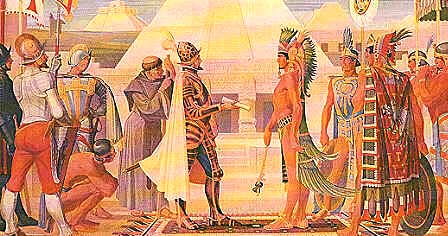 nishing the people of Earth for their wickedness. That's also similar to the Aztecs, who initially worshipped Cortez as a god, because their prophesies foretold of a light-skinned god with flaming red hair. The Martians rain death and destruction wherever they go, not to dissimilarly to the Angels of Death from the Old Testament and Book of Revelation.
The panic associated with the alien attack actually happened in real life, also. In 1938, the actor and director Orson Welles performed an adaptation of War of the Worlds on the radio. Many listeners took it as a real report of an alien attack, and in some places, especially in New Jersey, there was widespread panic. People were already on edge because of the tensions in Europe that would eventually lead to World War II, and some listeners believed it was actually the Germans, not the Martians attacking. That broadcast was an good example of how an alien attack may actually play out if it happened today.
Wednesday, October 7, 2009
War Of The Worlds by H.G. Wells (Intro-Chapter 1-4)
I'm reading War of the Worlds because I've read it before. Not in a re-read-it-to-get-out-of-independent-reading sense, but a I-read-this-before-but-now-I-actually-understand-everything sense. When I last read it, I read for the story--aliens invade Earth, humans fight back. This time, I want to read for meaning: the book is filled with allegories and metaphors. The story is enthralling, but the underlying themes--brilliantly elaborated on in an introduction by Orson Scott Card, the author of Ender's Game--make it an essential read.
The first few chapters describe the observing of a mysterious cylinder that makes its way to Earth, seemingly from Mars. Of interest is not just the cylinder, but of the reaction of people on Earth. The news does not make widespread attention until the cylinder actually lands, and most people simply rationalize the mysterious astronomic happenings as natural occurrences on Mars. If ignorance is bliss, then the mild inhabitants of the London suburbs act like the Lotus-eaters of The Odyssey. Even when the cylinder lands, it is treated as a curiosity, a thing to be oohed and aahed at, not something that could possibly contain intelligent life. The parallels to European colonialism are clear: this is the moment right before the Spanish start slaughtering the Aztecs. More next week.
The first few chapters describe the observing of a mysterious cylinder that makes its way to Earth, seemingly from Mars. Of interest is not just the cylinder, but of the reaction of people on Earth. The news does not make widespread attention until the cylinder actually lands, and most people simply rationalize the mysterious astronomic happenings as natural occurrences on Mars. If ignorance is bliss, then the mild inhabitants of the London suburbs act like the Lotus-eaters of The Odyssey. Even when the cylinder lands, it is treated as a curiosity, a thing to be oohed and aahed at, not something that could possibly contain intelligent life. The parallels to European colonialism are clear: this is the moment right before the Spanish start slaughtering the Aztecs. More next week.
Wednesday, September 30, 2009
The Last Shot/The Blind Side (Part 2)
Michael Lewis is best known for Moneyball, a candid portrayal of Billy Beane, the fiery and controversial Oakland Athletics general manager. Here he tackles a different, two-sided enigma: how did Michael Oher, a poor black teenager from the slums of Memphis who had had virtually no formal education, end up at Briarcrest Christian School, a swanky private school on the outskirts of Memphis, as a the adopted son of a wealthy, evangelical, Republican family (and why do certain offensive linemen get paid so much)? The answer lies in the curious position of a football left tackle. Charged with protecting the book's namesake, the quarterback's blind side, the left tackle has become an increasingly specialized position, demanding an athlete who is almost inhumanly tall, fast, and strong. Jonathan Ogden, one of the left tackles described in the book, is 6'9", 345 lbs., an All-American in both football and track and field who might have been the fastest person on his team in a 20-yard dash. The book splits into two narrative paths in following the story of the left tackle. One path follows the evolution of the players to play the position, from then to now. This part, while very educational, occasionally can get a bit dry when discussing more technical aspects, but is interesting for any football fan. Noteworthy is a story of how Bill Walsh's San Fransisco 49ers had to devise a special gameplan to deal with Lawrence Taylor. The other side is Oher's journey from the Memphis streets to Briarcrest and eventually to the NFL, as he was a first round pick of the Baltimore Ravens this year. His travels were made possibly by the incredible generosity of the Tuohys, a wealthy family who basically sponsored his education and helped him achieve a goal of getting into college. The story is intriguing because you so rarely hear a feel-good story like this, and yet it happened with success.

Wednesday, September 23, 2009
Nine Stories by J.D. Salinger
I suppose I shouldn't really have expected the stories of Nine Stories to be bright and upbeat, but they weren't what anyone would call even mildly happy reading. The stories were uniformly depressing--and excellent. The beginning tale, "A Perfect Day For Bananafish", is one of Salinger's most famous. The story is simultaneously horrifying and profound, shocking and sublime. It is so short that to go into detail would be to ruin the whole experience, but the simple premise of the plot is laden with description. The next two stories, "Uncle Wiggily In Connecticut" and "Just Before The War With The Eskimos", are tales of middle and upper-middle class abandon. While not as powerful as "Bananafish", they advance a sense of gloom and despair. "The Laughing Man" is the next story, and it is quite possibly my favorite story from the collection. Told by an older narrator who is recalling a childhood experience, it contrasts the pure power of storytelling with the grounding reality of life. That story and the next, "Down At The Dinghy", provide a sense of childlike illusion, emphasis on the illusion. "For Esme -- With Love and Squalor", is appropriately set in squalid WWII Europe. Fans of Lemony Snicket's A Series of Unfortunate Events will recognize the title--one of the characters is named Esme Squalor. The story follows an American GI and the precocious French girl he meets. Unlike the other stories, though, it is not so much about the plot, but rather in how Salinger crafts a repellently vivid setting for his characters. "Pretty Mouth and Green My Eyes" fits in with "Uncle Wiggily" and "Just Before" in terms of being a solid story of decadent American life, but it 's nothing spectacular. "De Daumier-Smith's Blue Period" follows with a protagonist completely unlike any other in the collection. The tale follows a French artist in America, trying to con his way to success; only, in the spirit of the book, it's so much more complicated than that. The final story, "Teddy", is a story that can oly be described and experienced personally. Read it to find out.
Sunday, September 13, 2009
The Last Shot by Darcy Frey/The Blind Side by Michael Lewis (Part 1)
The world of college sports recruiting is a murky one for top prospects, filled with illegitimate agents and sneaker deals and NCAA requirements. Often college is simply a short stop on the road to professional stardom, but even so, top programs will do anything to make sure that Player X is on their team. Double goes for shoe/apparel companies. Tiger Woods is the highest paid athlete in professional sports, not solely because he is an extremely talented golfer, but because Nike, Gatorade, and AT&T, among others, pay him a combined total of around $105 million (Link) simply for advertising their products. Nike is particularly aggressive in signing young athletes. Nike's various summer basketball camps, where free sneakers and college coaches abound, are seen as the ticket to the big time for an aspiring basketball star. It is into this world that the New York City kids of The Last Shot and the massive left tackle of The Blind Side are thrown into by the selective nature of talent.
The Last Shot delves deep into the heart of Brooklyn to Abraham Lincoln High School in Coney Island. The Lincoln Railsplitters consistently field one of the best high school teams in the nation, mostly made up of poor, African-American kids who have no future outside of basketball. Frey follows four such players for six months in the summer of 1992: Tchaka Shipp, Corey Robinson, Darryl Flicking (name changed to Russell Simmons in the book), and the youngest, only a freshman at the time, Stephon Marbury. For those not acquainted with the NBA, Marbury is now a 2-time All-Star who at one point was one of the best point guards in the game, and who along with Allen Iverson, ushered in a new era of the score-first point guard. Despite this impending stardom, Marbury comes off in the book as a self-possessed hanger-on whose talents far exceed his maturity. The book really focuses on the trials of the three seniors' attempts to make a NCAA (National Collegiate Athletic Association) Division 1 basketball program. The main obstacle is Proposition 48, an NCAA requirement forcing high-schools seniors to score at least 700 (out of 1800) on their SATs to qualify for Division 1.
The story is interesting not just for the enthralling stories and games of the players, but for the sheer shock of how different it is for an inner-city recruit to make it to a high-level college as compared to an athlete from a more prosperous background. While it is nice to think that college athletics should be at least a little bit about academics, the arcane SAT requirements lead to more problems than they're worth. Rather than punishing players for a bad background, the NCAA should make it easier for them to get the education they will receive at a Division 1 school. The three players in the book are kids no different than your average high schooler, and that makes The Last Shot an entertaining read.
(Part 2: The Blind Side coming next week)
The Last Shot delves deep into the heart of Brooklyn to Abraham Lincoln High School in Coney Island. The Lincoln Railsplitters consistently field one of the best high school teams in the nation, mostly made up of poor, African-American kids who have no future outside of basketball. Frey follows four such players for six months in the summer of 1992: Tchaka Shipp, Corey Robinson, Darryl Flicking (name changed to Russell Simmons in the book), and the youngest, only a freshman at the time, Stephon Marbury. For those not acquainted with the NBA, Marbury is now a 2-time All-Star who at one point was one of the best point guards in the game, and who along with Allen Iverson, ushered in a new era of the score-first point guard. Despite this impending stardom, Marbury comes off in the book as a self-possessed hanger-on whose talents far exceed his maturity. The book really focuses on the trials of the three seniors' attempts to make a NCAA (National Collegiate Athletic Association) Division 1 basketball program. The main obstacle is Proposition 48, an NCAA requirement forcing high-schools seniors to score at least 700 (out of 1800) on their SATs to qualify for Division 1.
The story is interesting not just for the enthralling stories and games of the players, but for the sheer shock of how different it is for an inner-city recruit to make it to a high-level college as compared to an athlete from a more prosperous background. While it is nice to think that college athletics should be at least a little bit about academics, the arcane SAT requirements lead to more problems than they're worth. Rather than punishing players for a bad background, the NCAA should make it easier for them to get the education they will receive at a Division 1 school. The three players in the book are kids no different than your average high schooler, and that makes The Last Shot an entertaining read.
(Part 2: The Blind Side coming next week)
Saturday, September 12, 2009
Summer For The Gods by Edward Larson
The Scopes trial was a defining moment in American history, where a controversial Tennessee anti-evolution statue turned into a nationwide battle between religious fundamentalists and scientific free thinkers. In 1925, a Tennessee teacher, John Scopes, had volunteered to be a constitutional test case against a Tennessee law banning the teaching of evolution. The American Civil Liberties Union (ACLU) backed Scopes, seeking to strike down the law as an unconstitutional infringement of civil liberties.
The protagonists in the book, William Jennings Bryan and Clarence Darrow, are both men with agendas that reach far beyond the courtroom where the trial is being held. Bryan is a populist, "The Great Commoner", a man who rose to national prominence (similarly to Barack Obama) with a fiery speech at the 1896 Democratic Convention about the evils of the gold standard, declaring "You shall not crucify mankind upon a cross of gold". That speech won him the nomination, and he would lose a closely contested race to William McKinley in the general election. At the time of the trial, however, Bryan is out of politics, having been a three-time loser in the presidential race. Still a national figure, Bryan has taken up a variety of fundamentalist causes, such as Prohibition and anti-Darwinism. His opposite in the trial, Clarence Darrow, is different from him in almost every way. Darrow is "America's leading defense lawyer", an agnostic whose previous case, that of Leopold and Loeb, two wealthy University of Chicago students who were accused of killing a 14-year old boy, had also played out on a national scene. Convinced by Darrow, the students had pleaded guilty, but Darrow, much to the anger of many, managed to avoid the death penalty for his clients, arguing that their actions were the product of the their environment, and thus the defendants could not be executed. Darrow had already announced his retirement when the legal action against Scopes was taken, but offers his services free of charge when he hears that Bryan will argue for the state of Tennessee.
The book seeks to be an alternative to the fictionalized version of the Scopes trial that was presented in the play Inherit The Wind (1955), which was meant more as a parable for the ongoing McCarthy trials than as an accurate historical representation; indeed, the play even used pseudonyms for the actual figures in the trial. Nevertheless, the play was a massive success, and the resulting revivals and film adaptations popularized a skewed version of the actual events. In the play, Darrow is portrayed as an invincible crusader and Bryan as an out-of-touch fool who believes every word in the Bible literally. What Larson does in Summer for the Gods is to present a unbiased, facts-based presentation of the trial, laying out the circumstances and letting the reader draw his/her own conclusions. The book is strongest in the details, exploring every point of the story and letting the narrative speak for itself. The story never feels like Larson is pasting a preconceived notion on; rather, he is simply reviving a debate that has faded as America has progressed.
The book is very well written, but a prospective reader looking to find Inherit The Wind II will be sorely disappointed. Larson is a historian first and foremost, and the story can get a bit dry at times. However, for someone who has previously read and enjoyed non-fiction, I would highly recommend it.
The protagonists in the book, William Jennings Bryan and Clarence Darrow, are both men with agendas that reach far beyond the courtroom where the trial is being held. Bryan is a populist, "The Great Commoner", a man who rose to national prominence (similarly to Barack Obama) with a fiery speech at the 1896 Democratic Convention about the evils of the gold standard, declaring "You shall not crucify mankind upon a cross of gold". That speech won him the nomination, and he would lose a closely contested race to William McKinley in the general election. At the time of the trial, however, Bryan is out of politics, having been a three-time loser in the presidential race. Still a national figure, Bryan has taken up a variety of fundamentalist causes, such as Prohibition and anti-Darwinism. His opposite in the trial, Clarence Darrow, is different from him in almost every way. Darrow is "America's leading defense lawyer", an agnostic whose previous case, that of Leopold and Loeb, two wealthy University of Chicago students who were accused of killing a 14-year old boy, had also played out on a national scene. Convinced by Darrow, the students had pleaded guilty, but Darrow, much to the anger of many, managed to avoid the death penalty for his clients, arguing that their actions were the product of the their environment, and thus the defendants could not be executed. Darrow had already announced his retirement when the legal action against Scopes was taken, but offers his services free of charge when he hears that Bryan will argue for the state of Tennessee.
The book seeks to be an alternative to the fictionalized version of the Scopes trial that was presented in the play Inherit The Wind (1955), which was meant more as a parable for the ongoing McCarthy trials than as an accurate historical representation; indeed, the play even used pseudonyms for the actual figures in the trial. Nevertheless, the play was a massive success, and the resulting revivals and film adaptations popularized a skewed version of the actual events. In the play, Darrow is portrayed as an invincible crusader and Bryan as an out-of-touch fool who believes every word in the Bible literally. What Larson does in Summer for the Gods is to present a unbiased, facts-based presentation of the trial, laying out the circumstances and letting the reader draw his/her own conclusions. The book is strongest in the details, exploring every point of the story and letting the narrative speak for itself. The story never feels like Larson is pasting a preconceived notion on; rather, he is simply reviving a debate that has faded as America has progressed.
The book is very well written, but a prospective reader looking to find Inherit The Wind II will be sorely disappointed. Larson is a historian first and foremost, and the story can get a bit dry at times. However, for someone who has previously read and enjoyed non-fiction, I would highly recommend it.
Subscribe to:
Posts (Atom)