Wednesday, October 28, 2009
War of the Worlds (Part 1 Summation)
The first part of the war is over, and Earth is defeated. The Martians have invaded and destroyed most of humanity, burning acres at a time with their Heat Ray and killing thousands with the Black Smoke. Humanity has put up token resistance, but for the most part the Martians have advanced unchecked. As previously noted, this story can be read as an allegory for European colonization of Africa and the Americas. If this metaphor is to be applied to Part 1, it can be seen as the conquering stage of colonization, when Cortes and Pizarro overwhelmed the indigenous peoples with their guns and horses, enslaving entire peoples. In essence, there is no real difference between the two scenarios--except that since the idea of a Martian invasion is foreign to us, we treat it as if it is some great offense against morality. The Martians are portrayed invincibly, the German blitzkreig, Attila the Hun, and Alexander the Great all rolled into one, as the invading colonization forces must have seemed to the native Americans. In writing this book, H.G. Wells did not just seek to write an excellent science fiction story, he also sought to educate people who may have had a one-sided view about the atrocities committed during European colonization.

Monday, October 19, 2009
War of the Worlds by H.G. Wells (Chapters 12-16)
The narrative of these chapters mainly deals with the tale of the narrator's brother, who has fled London for the country, where he meets up with two ladies also fleeing the city. This would be a short, unimportant vignette, but for Wells's masterful description of a fleeing townspeople. The three companions happen upon a town which has gotten wind of the Martian invasion and collectively decided to flee for greener pastures. Their horse and buggy was forced to stop, "for the main road was a boiling stream of people, a torrent of human beings pressing northward, one pressing on another" (151). The mass exodus of an entire village--unplanned--is no easy logistical feat, and the sheer amount of people on one road may pose more danger than the Martians themselves. The story can be read as an allegory of the damage that humans pose to ourselves in panics. Overreactions and mass hysteria rarely have a positive result, such as in the swine flu scare of 1976. The story is a potent one, warning of the dangers of group-think and forecasting what could possibly happen in a modern-day scenario.
Tuesday, October 13, 2009
War Of The Worlds by H.G. Wells (Chapters 4-12)
"It was sweeping round slowly and steadily, this flaming death, this invisible, inevitable sword of heat." (39)
A ray that can kill without seeing, massive machines that tower over even the tallest buildings, and a taste for death and destruction. These are the weapons the Martians have leveled against the human population of Earth, attempting to destroy them for their land. Earth is a fertile place, and the Martians have set their sights on it. Like the European colonists must have seemed to the natives of Africa and America with their guns and horses (Cortez), the Martians simply overwhelm the first Earthlings they encounter with sheer surprise. Although it is not mentioned in the book, if this were to happen today, I'm sure that there would people who would take it as a sign that God was pu nishing the people of Earth for their wickedness. That's also similar to the Aztecs, who initially worshipped Cortez as a god, because their prophesies foretold of a light-skinned god with flaming red hair. The Martians rain death and destruction wherever they go, not to dissimilarly to the Angels of Death from the Old Testament and Book of Revelation.
The panic associated with the alien attack actually happened in real life, also. In 1938, the actor and director Orson Welles performed an adaptation of War of the Worlds on the radio. Many listeners took it as a real report of an alien attack, and in some places, especially in New Jersey, there was widespread panic. People were already on edge because of the tensions in Europe that would eventually lead to World War II, and some listeners believed it was actually the Germans, not the Martians attacking. That broadcast was an good example of how an alien attack may actually play out if it happened today.
A ray that can kill without seeing, massive machines that tower over even the tallest buildings, and a taste for death and destruction. These are the weapons the Martians have leveled against the human population of Earth, attempting to destroy them for their land. Earth is a fertile place, and the Martians have set their sights on it. Like the European colonists must have seemed to the natives of Africa and America with their guns and horses (Cortez), the Martians simply overwhelm the first Earthlings they encounter with sheer surprise. Although it is not mentioned in the book, if this were to happen today, I'm sure that there would people who would take it as a sign that God was pu
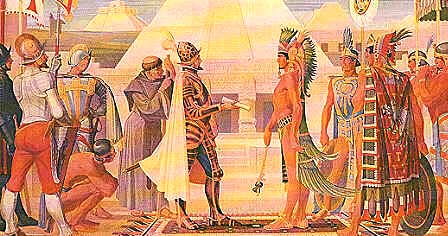 nishing the people of Earth for their wickedness. That's also similar to the Aztecs, who initially worshipped Cortez as a god, because their prophesies foretold of a light-skinned god with flaming red hair. The Martians rain death and destruction wherever they go, not to dissimilarly to the Angels of Death from the Old Testament and Book of Revelation.
The panic associated with the alien attack actually happened in real life, also. In 1938, the actor and director Orson Welles performed an adaptation of War of the Worlds on the radio. Many listeners took it as a real report of an alien attack, and in some places, especially in New Jersey, there was widespread panic. People were already on edge because of the tensions in Europe that would eventually lead to World War II, and some listeners believed it was actually the Germans, not the Martians attacking. That broadcast was an good example of how an alien attack may actually play out if it happened today.
Wednesday, October 7, 2009
War Of The Worlds by H.G. Wells (Intro-Chapter 1-4)
I'm reading War of the Worlds because I've read it before. Not in a re-read-it-to-get-out-of-independent-reading sense, but a I-read-this-before-but-now-I-actually-understand-everything sense. When I last read it, I read for the story--aliens invade Earth, humans fight back. This time, I want to read for meaning: the book is filled with allegories and metaphors. The story is enthralling, but the underlying themes--brilliantly elaborated on in an introduction by Orson Scott Card, the author of Ender's Game--make it an essential read.
The first few chapters describe the observing of a mysterious cylinder that makes its way to Earth, seemingly from Mars. Of interest is not just the cylinder, but of the reaction of people on Earth. The news does not make widespread attention until the cylinder actually lands, and most people simply rationalize the mysterious astronomic happenings as natural occurrences on Mars. If ignorance is bliss, then the mild inhabitants of the London suburbs act like the Lotus-eaters of The Odyssey. Even when the cylinder lands, it is treated as a curiosity, a thing to be oohed and aahed at, not something that could possibly contain intelligent life. The parallels to European colonialism are clear: this is the moment right before the Spanish start slaughtering the Aztecs. More next week.
The first few chapters describe the observing of a mysterious cylinder that makes its way to Earth, seemingly from Mars. Of interest is not just the cylinder, but of the reaction of people on Earth. The news does not make widespread attention until the cylinder actually lands, and most people simply rationalize the mysterious astronomic happenings as natural occurrences on Mars. If ignorance is bliss, then the mild inhabitants of the London suburbs act like the Lotus-eaters of The Odyssey. Even when the cylinder lands, it is treated as a curiosity, a thing to be oohed and aahed at, not something that could possibly contain intelligent life. The parallels to European colonialism are clear: this is the moment right before the Spanish start slaughtering the Aztecs. More next week.
Subscribe to:
Posts (Atom)