Wednesday, September 30, 2009
The Last Shot/The Blind Side (Part 2)
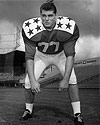
Michael Lewis is best known for Moneyball, a candid portrayal of Billy Beane, the fiery and controversial Oakland Athletics general manager. Here he tackles a different, two-sided enigma: how did Michael Oher, a poor black teenager from the slums of Memphis who had had virtually no formal education, end up at Briarcrest Christian School, a swanky private school on the outskirts of Memphis, as a the adopted son of a wealthy, evangelical, Republican family (and why do certain offensive linemen get paid so much)? The answer lies in the curious position of a football left tackle. Charged with protecting the book's namesake, the quarterback's blind side, the left tackle has become an increasingly specialized position, demanding an athlete who is almost inhumanly tall, fast, and strong. Jonathan Ogden, one of the left tackles described in the book, is 6'9", 345 lbs., an All-American in both football and track and field who might have been the fastest person on his team in a 20-yard dash. The book splits into two narrative paths in following the story of the left tackle. One path follows the evolution of the players to play the position, from then to now. This part, while very educational, occasionally can get a bit dry when discussing more technical aspects, but is interesting for any football fan. Noteworthy is a story of how Bill Walsh's San Fransisco 49ers had to devise a special gameplan to deal with Lawrence Taylor. The other side is Oher's journey from the Memphis streets to Briarcrest and eventually to the NFL, as he was a first round pick of the Baltimore Ravens this year. His travels were made possibly by the incredible generosity of the Tuohys, a wealthy family who basically sponsored his education and helped him achieve a goal of getting into college. The story is intriguing because you so rarely hear a feel-good story like this, and yet it happened with success.


Wednesday, September 23, 2009
Nine Stories by J.D. Salinger
I suppose I shouldn't really have expected the stories of Nine Stories to be bright and upbeat, but they weren't what anyone would call even mildly happy reading. The stories were uniformly depressing--and excellent. The beginning tale, "A Perfect Day For Bananafish", is one of Salinger's most famous. The story is simultaneously horrifying and profound, shocking and sublime. It is so short that to go into detail would be to ruin the whole experience, but the simple premise of the plot is laden with description. The next two stories, "Uncle Wiggily In Connecticut" and "Just Before The War With The Eskimos", are tales of middle and upper-middle class abandon. While not as powerful as "Bananafish", they advance a sense of gloom and despair. "The Laughing Man" is the next story, and it is quite possibly my favorite story from the collection. Told by an older narrator who is recalling a childhood experience, it contrasts the pure power of storytelling with the grounding reality of life. That story and the next, "Down At The Dinghy", provide a sense of childlike illusion, emphasis on the illusion. "For Esme -- With Love and Squalor", is appropriately set in squalid WWII Europe. Fans of Lemony Snicket's A Series of Unfortunate Events will recognize the title--one of the characters is named Esme Squalor. The story follows an American GI and the precocious French girl he meets. Unlike the other stories, though, it is not so much about the plot, but rather in how Salinger crafts a repellently vivid setting for his characters. "Pretty Mouth and Green My Eyes" fits in with "Uncle Wiggily" and "Just Before" in terms of being a solid story of decadent American life, but it 's nothing spectacular. "De Daumier-Smith's Blue Period" follows with a protagonist completely unlike any other in the collection. The tale follows a French artist in America, trying to con his way to success; only, in the spirit of the book, it's so much more complicated than that. The final story, "Teddy", is a story that can oly be described and experienced personally. Read it to find out.
Sunday, September 13, 2009
The Last Shot by Darcy Frey/The Blind Side by Michael Lewis (Part 1)
The world of college sports recruiting is a murky one for top prospects, filled with illegitimate agents and sneaker deals and NCAA requirements. Often college is simply a short stop on the road to professional stardom, but even so, top programs will do anything to make sure that Player X is on their team. Double goes for shoe/apparel companies. Tiger Woods is the highest paid athlete in professional sports, not solely because he is an extremely talented golfer, but because Nike, Gatorade, and AT&T, among others, pay him a combined total of around $105 million (Link) simply for advertising their products. Nike is particularly aggressive in signing young athletes. Nike's various summer basketball camps, where free sneakers and college coaches abound, are seen as the ticket to the big time for an aspiring basketball star. It is into this world that the New York City kids of The Last Shot and the massive left tackle of The Blind Side are thrown into by the selective nature of talent.
The Last Shot delves deep into the heart of Brooklyn to Abraham Lincoln High School in Coney Island. The Lincoln Railsplitters consistently field one of the best high school teams in the nation, mostly made up of poor, African-American kids who have no future outside of basketball. Frey follows four such players for six months in the summer of 1992: Tchaka Shipp, Corey Robinson, Darryl Flicking (name changed to Russell Simmons in the book), and the youngest, only a freshman at the time, Stephon Marbury. For those not acquainted with the NBA, Marbury is now a 2-time All-Star who at one point was one of the best point guards in the game, and who along with Allen Iverson, ushered in a new era of the score-first point guard. Despite this impending stardom, Marbury comes off in the book as a self-possessed hanger-on whose talents far exceed his maturity. The book really focuses on the trials of the three seniors' attempts to make a NCAA (National Collegiate Athletic Association) Division 1 basketball program. The main obstacle is Proposition 48, an NCAA requirement forcing high-schools seniors to score at least 700 (out of 1800) on their SATs to qualify for Division 1.
The story is interesting not just for the enthralling stories and games of the players, but for the sheer shock of how different it is for an inner-city recruit to make it to a high-level college as compared to an athlete from a more prosperous background. While it is nice to think that college athletics should be at least a little bit about academics, the arcane SAT requirements lead to more problems than they're worth. Rather than punishing players for a bad background, the NCAA should make it easier for them to get the education they will receive at a Division 1 school. The three players in the book are kids no different than your average high schooler, and that makes The Last Shot an entertaining read.
(Part 2: The Blind Side coming next week)
The Last Shot delves deep into the heart of Brooklyn to Abraham Lincoln High School in Coney Island. The Lincoln Railsplitters consistently field one of the best high school teams in the nation, mostly made up of poor, African-American kids who have no future outside of basketball. Frey follows four such players for six months in the summer of 1992: Tchaka Shipp, Corey Robinson, Darryl Flicking (name changed to Russell Simmons in the book), and the youngest, only a freshman at the time, Stephon Marbury. For those not acquainted with the NBA, Marbury is now a 2-time All-Star who at one point was one of the best point guards in the game, and who along with Allen Iverson, ushered in a new era of the score-first point guard. Despite this impending stardom, Marbury comes off in the book as a self-possessed hanger-on whose talents far exceed his maturity. The book really focuses on the trials of the three seniors' attempts to make a NCAA (National Collegiate Athletic Association) Division 1 basketball program. The main obstacle is Proposition 48, an NCAA requirement forcing high-schools seniors to score at least 700 (out of 1800) on their SATs to qualify for Division 1.
The story is interesting not just for the enthralling stories and games of the players, but for the sheer shock of how different it is for an inner-city recruit to make it to a high-level college as compared to an athlete from a more prosperous background. While it is nice to think that college athletics should be at least a little bit about academics, the arcane SAT requirements lead to more problems than they're worth. Rather than punishing players for a bad background, the NCAA should make it easier for them to get the education they will receive at a Division 1 school. The three players in the book are kids no different than your average high schooler, and that makes The Last Shot an entertaining read.
(Part 2: The Blind Side coming next week)
Saturday, September 12, 2009
Summer For The Gods by Edward Larson
The Scopes trial was a defining moment in American history, where a controversial Tennessee anti-evolution statue turned into a nationwide battle between religious fundamentalists and scientific free thinkers. In 1925, a Tennessee teacher, John Scopes, had volunteered to be a constitutional test case against a Tennessee law banning the teaching of evolution. The American Civil Liberties Union (ACLU) backed Scopes, seeking to strike down the law as an unconstitutional infringement of civil liberties.
The protagonists in the book, William Jennings Bryan and Clarence Darrow, are both men with agendas that reach far beyond the courtroom where the trial is being held. Bryan is a populist, "The Great Commoner", a man who rose to national prominence (similarly to Barack Obama) with a fiery speech at the 1896 Democratic Convention about the evils of the gold standard, declaring "You shall not crucify mankind upon a cross of gold". That speech won him the nomination, and he would lose a closely contested race to William McKinley in the general election. At the time of the trial, however, Bryan is out of politics, having been a three-time loser in the presidential race. Still a national figure, Bryan has taken up a variety of fundamentalist causes, such as Prohibition and anti-Darwinism. His opposite in the trial, Clarence Darrow, is different from him in almost every way. Darrow is "America's leading defense lawyer", an agnostic whose previous case, that of Leopold and Loeb, two wealthy University of Chicago students who were accused of killing a 14-year old boy, had also played out on a national scene. Convinced by Darrow, the students had pleaded guilty, but Darrow, much to the anger of many, managed to avoid the death penalty for his clients, arguing that their actions were the product of the their environment, and thus the defendants could not be executed. Darrow had already announced his retirement when the legal action against Scopes was taken, but offers his services free of charge when he hears that Bryan will argue for the state of Tennessee.
The book seeks to be an alternative to the fictionalized version of the Scopes trial that was presented in the play Inherit The Wind (1955), which was meant more as a parable for the ongoing McCarthy trials than as an accurate historical representation; indeed, the play even used pseudonyms for the actual figures in the trial. Nevertheless, the play was a massive success, and the resulting revivals and film adaptations popularized a skewed version of the actual events. In the play, Darrow is portrayed as an invincible crusader and Bryan as an out-of-touch fool who believes every word in the Bible literally. What Larson does in Summer for the Gods is to present a unbiased, facts-based presentation of the trial, laying out the circumstances and letting the reader draw his/her own conclusions. The book is strongest in the details, exploring every point of the story and letting the narrative speak for itself. The story never feels like Larson is pasting a preconceived notion on; rather, he is simply reviving a debate that has faded as America has progressed.
The book is very well written, but a prospective reader looking to find Inherit The Wind II will be sorely disappointed. Larson is a historian first and foremost, and the story can get a bit dry at times. However, for someone who has previously read and enjoyed non-fiction, I would highly recommend it.
The protagonists in the book, William Jennings Bryan and Clarence Darrow, are both men with agendas that reach far beyond the courtroom where the trial is being held. Bryan is a populist, "The Great Commoner", a man who rose to national prominence (similarly to Barack Obama) with a fiery speech at the 1896 Democratic Convention about the evils of the gold standard, declaring "You shall not crucify mankind upon a cross of gold". That speech won him the nomination, and he would lose a closely contested race to William McKinley in the general election. At the time of the trial, however, Bryan is out of politics, having been a three-time loser in the presidential race. Still a national figure, Bryan has taken up a variety of fundamentalist causes, such as Prohibition and anti-Darwinism. His opposite in the trial, Clarence Darrow, is different from him in almost every way. Darrow is "America's leading defense lawyer", an agnostic whose previous case, that of Leopold and Loeb, two wealthy University of Chicago students who were accused of killing a 14-year old boy, had also played out on a national scene. Convinced by Darrow, the students had pleaded guilty, but Darrow, much to the anger of many, managed to avoid the death penalty for his clients, arguing that their actions were the product of the their environment, and thus the defendants could not be executed. Darrow had already announced his retirement when the legal action against Scopes was taken, but offers his services free of charge when he hears that Bryan will argue for the state of Tennessee.
The book seeks to be an alternative to the fictionalized version of the Scopes trial that was presented in the play Inherit The Wind (1955), which was meant more as a parable for the ongoing McCarthy trials than as an accurate historical representation; indeed, the play even used pseudonyms for the actual figures in the trial. Nevertheless, the play was a massive success, and the resulting revivals and film adaptations popularized a skewed version of the actual events. In the play, Darrow is portrayed as an invincible crusader and Bryan as an out-of-touch fool who believes every word in the Bible literally. What Larson does in Summer for the Gods is to present a unbiased, facts-based presentation of the trial, laying out the circumstances and letting the reader draw his/her own conclusions. The book is strongest in the details, exploring every point of the story and letting the narrative speak for itself. The story never feels like Larson is pasting a preconceived notion on; rather, he is simply reviving a debate that has faded as America has progressed.
The book is very well written, but a prospective reader looking to find Inherit The Wind II will be sorely disappointed. Larson is a historian first and foremost, and the story can get a bit dry at times. However, for someone who has previously read and enjoyed non-fiction, I would highly recommend it.
Subscribe to:
Posts (Atom)